
Rybovich‑built mezzanine
Renovated mezzanine with seating over freezer boxes, refrigerated storage, five tackle drawers, Eskimo 480 ice dump, rocket launcher and teak fighting chair.

Private Sale · Fort Pierce, Florida
76′ Knight & Carver
Custom‑Built Sportfisherman
Rybovich‑renovated · 6½″ hull · They don’t build them like this anymore
The Boat
Read her build year and you form a picture. Then you step aboard and the picture falls apart.
Between 2017 and 2018 Michael Rybovich & Sons — the name that defines this class of boat — took her apart and rebuilt her. Back bulkhead redesigned and rebuilt. New teak decks. New mezzanine. Aft galley redesigned from scratch. New windows and frames. Rebuilt davit. A Seakeeper SK26 installed. That is not a refresh. That is a second launch.
What followed reads like a boat that was never allowed to age. Both 30 kW Northern Lights generators rebuilt. Shafts, cutlass bearings, five‑blade props and dripless seals renewed in 2020. Hydraulic steering replaced in 2022. 1,000‑hour CAT service by Smith & Wick in 2023, with new interior soft goods and lighting the same year. New flybridge enclosure in 2024. Fresh cutlass bearings, VHF radios and antennas in 2025.
And in 2024 the hull was sandblasted to bare, refaired and reglassed — the single largest structural expense any hull of this caliber can carry, done and behind her.
A buyer at this number is normally buying a project. Here the project is finished.
The Build
Laid up when yards competed on strength instead of schedule.
Six and a half inches of hull. Say that out loud to anyone who has run a modern production sportfisherman and watch the reaction.
That is where the ride comes from. A hull with that much mass and that much beam does not slam, does not flex and does not talk back in a head sea. She takes a four‑foot chop and turns it into a rumble somewhere below your feet. Crews who have fished her describe the ride the same way every time — uncannily quiet, uncannily solid. You feel it in your knees at the end of a long run home.
The reason nobody builds this way now is money. A hull like this eats material, labor and yard time that no modern spreadsheet will approve. Custom sportfishermen in the 65 to 80‑foot range trade between $3 million and $8 million, and boats of this size built in the last decade average $5.3 million. Commissioning her equivalent today, with this laminate and this joinery, is a multi‑year, seven‑figure conversation with a yard that may or may not say yes.
She was built in an era that ended. What she cost to build is not what she costs to buy.
Renovated mezzanine with seating over freezer boxes, refrigerated storage, five tackle drawers, Eskimo 480 ice dump, rocket launcher and teak fighting chair.
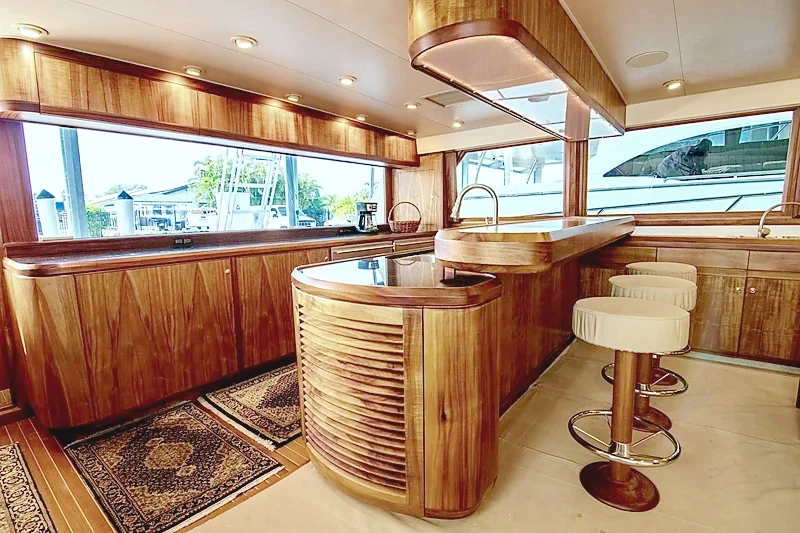
Counter‑rich aft galley with three‑burner glass range and oven, ice maker, four‑drawer refrigeration and deep cabinet storage — steps from the cockpit.

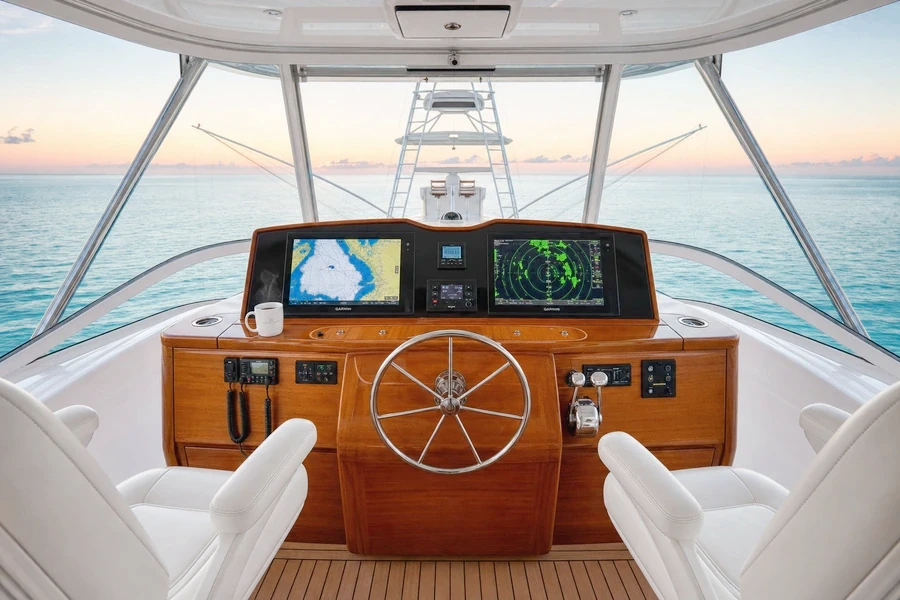
New flybridge enclosure in 2024 over a Garmin 8212 / 8617 and Furuno TZ3 25 kW open‑array package with Airmar 275LWH transducer. New VHF radios and antennas in 2025.

What She Says About You
You come off the inlet at twenty‑four knots with the riggers up, and heads turn before anyone can read the transom. Seventy‑six feet of white hull and a tower against the sky is not a boat people glance at. It is a boat people stop and look at.
Then they get close enough to see the teak, the varnish, the Rybovich cockpit, and the conversation changes. Anybody can buy length. Very few people show up in something built like this and kept like this.
She fishes the tournaments. She hosts the clients. She is the boat your friends ask to come out on, and the one they talk about on the drive home. At the marina bar, nobody asks what she cost. They ask who owns her.
The right buyer is not purchasing a vessel. He is stepping into a reputation that took thirty‑six years to build.
A Day Aboard
Not a hull. Not an hour meter. A Saturday you will think about for the rest of the week.
5:40 a.m.
You bring her up in the dark. Two CATs settle into that low idle you can feel through the deck more than hear, and the enclosure keeps the damp off the glass. By the time you clear the inlet the sky has gone the color of a peach and the outriggers are throwing long shadows across the cockpit. Twenty‑four knots. Nobody in front of you.
9:15 a.m.
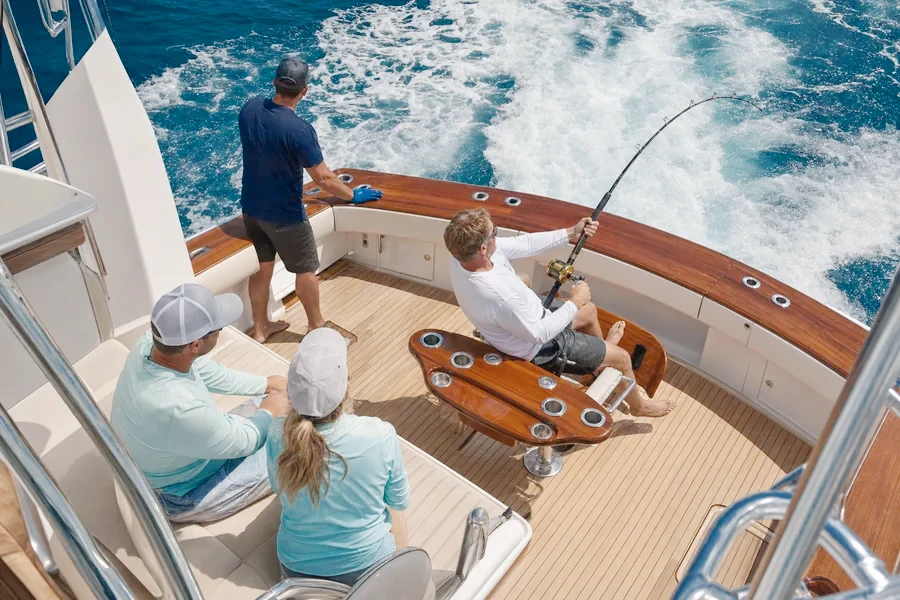
Somebody yells. The chair swings, the teak is warm underfoot, and the tackle you need is in the drawer three feet from your hip because a Rybovich crew put it there on purpose. The Seakeeper holds her flat while you fight. Twenty minutes later there is a fish alongside and six people on your boat losing their minds, and every one of them is going to tell that story tonight.
1:00 p.m.
The aft galley was redesigned so nobody has to leave the party. Range on, ice maker running, someone on a bar stool with wet shorts and a cold drink telling the story bigger than it happened. Air conditioning at your back, blue water over the transom, and a mezzanine full of people who are in no hurry to be anywhere else.
7:30 p.m.
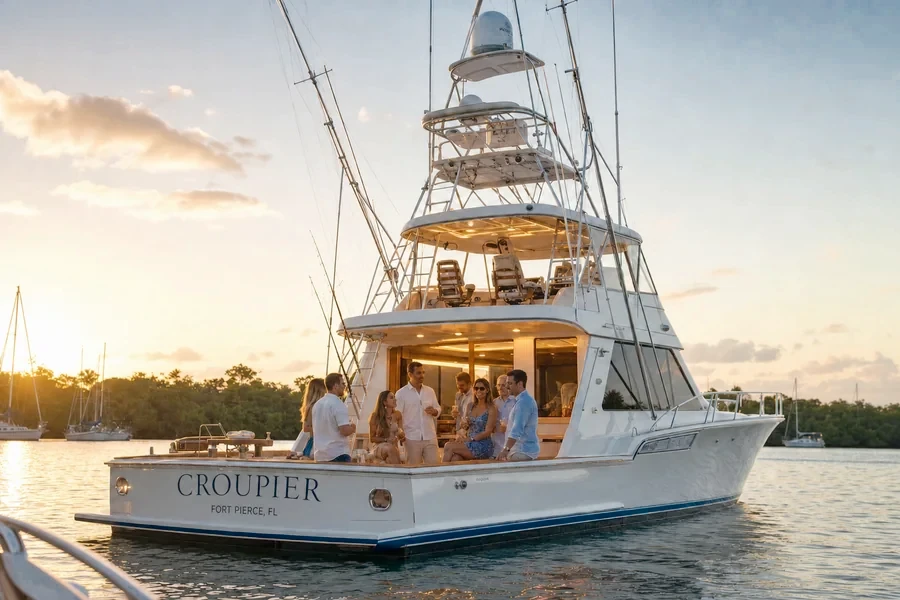
You tuck in behind the point, drop the hook, and the cockpit lights come up amber under the bridge. Somebody is pouring, somebody is still telling the story from this morning, and the varnish is catching the last of the light. Later the salon is full and the joinery glows. Three staterooms mean the ones who should not drive home do not have to. You wake up on your own boat, and you do it again tomorrow.
Nobody needs a boat like this. That has never been the point. You buy her because of who you are on the days you are aboard her.

Across the Stream
From the Palm Beach inlet it is fifty‑six miles to West End — a shade over two hours at her cruise. That is the whole barrier between a Florida slip and Bahamian water, and a boat like this erases it before the ice has melted.
She carries twenty‑five hundred and fifty gallons. The Exumas and back is a weekend she does not have to think about, and the enclosed bridge means you make the crossing in air conditioning with the sea behind you.
A tournament boat that also happens to be the best island cruiser you will ever own.
The Exumas
Fishing is what she was built for. This is what she does the rest of the year.
The front door
Nassau to Highbourne is thirty‑five miles — under two hours. A privately owned island with eight secluded beaches and a reef they call the Octopus Garden. Run south from there and the coral‑grown wreck of a Curtiss C‑46 lies in ten feet of water off Norman’s Cay, ditched on a smuggling run in November 1980 and never moved since.
The one they photograph
Thunderball Grotto is a hollow limestone islet with skylights that shaft sunlight down into a domed cavern full of snapper and angelfish — the location for two James Bond pictures. The pigs at Big Major Spot swim a hundred metres out to meet the boat. Nurse sharks at the Compass Cay dock, tame enough to wade among. Dinner at the Staniel Cay Yacht Club, founded 1956.
The quiet one
Established 1958 — the first land‑and‑sea park anywhere in the world, and the first no‑take marine reserve in the Caribbean. Take a mooring at Warderick Wells, walk up Boo Boo Hill, then spend a long lunch on one of the sandbars at Pipe Creek that shift with the tide and belong to whoever gets there first.
Sources: Islands of The Bahamas, Staniel Cay, Waterway Guide, Boatcrowd


Gallery
Specifications
Specifications and dimensions are believed accurate but are not guaranteed. Buyer to verify by independent survey and sea trial.
The Engines
Caterpillar’s 32‑litre V12 is the engine you specify when failure is not an option.
It is the flagship of the Cat marine line and the standard fit in the convertible sportfish world — the same platform that turns up in patrol boats, crew boats and commercial fleets that run hard for a living. Iron block, twelve cylinders, 1,632 horsepower a side and 3,264 combined — and a reputation for service life that is the whole reason people specify them.
They are also the easiest big diesel in the world to own. Every serious port from Fort Pierce to Cabo has a Cat dealer who knows the platform cold, parts are on the shelf rather than on a boat from Europe, and the ECM keeps an honest record a surveyor can pull in ten minutes.
CROUPIER was repowered with them in 2007, and in the nineteen years since she has put under 3,800 hours on the pair — roughly 200 a year, well below the light end of what Caterpillar considers normal pleasure use. On an engine with this kind of service life, that is barely run in.
The best engine in the class, lightly used, fully documented.
Hours per year since the repower
Annual‑use ranges per Caterpillar marine rating guidance. Hours to be verified by buyer at survey.
Refit History
The original engines came out and she was repowered with a pair of Caterpillar C32s, 1,632 hp each and 3,264 hp on the pair. Under 3,800 hours on them today. The repower predates every dollar of the Rybovich work — the engine room was settled first, then the rest of the boat was rebuilt around it.
Complete rebuild and redesign of the back bulkhead. New teak deck and mezzanine. Mezzanine freezer and refrigerator boxes. Redesigned galley with refrigeration drawers and ice maker. Port and starboard windows and frames replaced. Davit removed and rebuilt. Both 30 kW Northern Lights generators rebuilt and painted. Seakeeper SK26 installed. Teak fighting chair, rocket launcher, carpet throughout, 12V and 24V battery chargers.
All air‑conditioning compressors and air handlers replaced throughout. CAT C32 air coolers upgraded. Garmin 8617 display added.
New shafts, cutlass bearings, five‑blade S&S propellers and dripless seals — replaced at end of service life, not from damage. Eskimo 480 ice dump added to mezzanine.
Furuno TZ3 25 kW / 6′ open‑array radar installed. Hydraulic steering in the lazarette removed and replaced.
1,000‑hour CAT C32 service by Smith & Wick, Palm Beach. New interior soft goods throughout. New and upgraded interior lighting.
The hull was completely sandblasted, refaired and glassed — a full job taken down to bare substrate rather than a cosmetic recoat. This is the single largest structural expense a hull like hers can carry, and the one most buyers inherit as a future liability. Here it is already done.
A new flybridge enclosure went on the same year — fresh canvas and clear vinyl over the whole bridge, which is the piece that yellows, clouds and leaks first on a boat this size.
Cutlass bearings renewed again — the second set since 2020, replaced on schedule rather than on failure. It is the wear item that governs shaft alignment and telegraphs vibration through the whole boat when it is tired. Hers are fresh.
New VHF radios and new antennas throughout, so the communications suite matches the rest of the electronics package rather than lagging a generation behind it.

Full photo package, equipment inventory and service records available on request.
Click Here for AppointmentInquire
No gatekeeping and no phone tree. Call or text for the full package, to arrange a showing in Fort Pierce, or to discuss owner financing for qualified buyers.
